Writing a Scope of Work: Template, Examples, and Common Mistakes

Projects rarely crash and burn in one dramatic action movie moment. There's no explosion, no plotting villains - just regular people doing their jobs.
A manager adds a small feature, a developer builds what they think was requested, a designer remembers an extra step in the checkout flow that nobody else thought of. Each change feels reasonable and easy to justify.
By the time anyone realizes, the thing being built grows and grows each time someone says "can we just". Deadlines move, work expands, and now you're working on a project that never seems to be quite finished.
When things go wrong like this, it’s usually down to a lack of clarity about what was supposed to be done in the first place. And that always comes back to one thing: the scope of work wasn’t clear enough.
What we'll cover
- Why a scope of work matters
- Scope of work vs statement of work
- What to include in a scope of work
- Scope of work example
- Writing a statement or work
- Statement of work template
- Common mistakes to avoid
What is a scope of work
A scope of work answers "What exactly are we doing and where does it stop?" Sounds simple enough, but it rarely is.
Most projects start with a general idea of what needs to be done. Build this, improve that. Add a feature, redesign a flow. Everyone nods because it all sounds clear.
The problem is, "clear" means something different to each person involved. The manager thinks in terms of outcomes, the developer is focused on implementation, and the designer is thinking about how it should work for users. None of them are wrong, but they are looking at the project from different perspectives.
A scope of work takes those individual interpretations and turns them into a shared reference point. It defines:
- What's in
- What's out
- What done looks like
A clearly defined project scope keeps everyone on the same page. Without it, people fill in the gaps themselves - and that's the part that leads to scope creep.

Why a scope of work matters
If you've ever done project work and ended up with deliverables that weren't part of the original project plan, you're part of the statistic. As much as 52% of projects across the globe experience scope creep, which in turn leads to an average of 27% overrun on project costs.
In actual numbers, that's roughly $4,000 extra on a $15,000 project, all because project expectations weren't clearly defined. The larger the project, the more uncomfortable the numbers.
Besides the obvious financial consequences, you also need to factor in frustrated clients, burned out teams, endless revision cycles, and projects that feel almost done forever. And while a scope of work document won't completely eliminate changes, it will turn chaos into something you can see, discuss, and control before it spirals.
Scope of work vs statement of work
Before diving into specifics, it's worth clearing up a common source of confusion. The terms scope of work and statement of work (SOW) are so close that they often get used interchangeably.
In practice, they're not the same thing. A scope of work focuses on smooth project execution. Think budgets, resource allocation, project objectives, progress tracking, and individual tasks. If the project is internal, a scope of work can stand on its own.
Once a project moves into a client context, the scope of work is usually adapted so that it can be included in the statement of work. The statement of work is what pulls everything together into a formal agreement between the parties involved. Alongside the scope of work, it includes payment terms and gives legal protection to both you and the client.
| Scope of work | Statement of work |
| Internal | External |
| Informal document for team alignment | Formal sign-off document |
| Often a section within a comprehensive statement of work document | Includes legal and payment terms in addition to the scope of work |
What to include in a scope of work document
The point of a scope of work is to remove doubt. If someone joins the project halfway through and reads your scope, they should understand what’s going on without needing a long meeting to fill in the gaps. Here are the six essential elements your scope of work should cover.
1. Project background
Start with a project overview for context. Why does this project exist and what problem is it solving?
2. Project deliverables
List exactly what will be delivered at the end of the project. If it’s not written here, it’s not part of the project. That one rule alone can prevent a surprising amount of confusion later.
3. Budget
In a scope of work, a budget should show the internal estimated cost of the project. That means estimating the labor, tools, and other internal costs required to complete the work. Even if no money changes hands between teams, the project still consumes time and resources.
4. Project timeline
Break the project into phases with rough timelines or key milestones. Your project schedule doesn’t need to be set in stone, but it should make it easy to track progress and see delays when they happen.
5. Roles and responsibilities
Every project has a moment where something doesn’t get done because everyone assumed someone else had it covered. This section prevents that.
Define who is responsible for specific tasks, especially when multiple people or teams are involved. Clear ownership keeps things moving.
6. Exclusions
If scope of work documents had a most underrated section, this would be it.
As the word implies, exclusions define what is not included. Without them, the project quietly expands every time someone asks for “just one more thing".
Example: Scope of work for a 5-page website
Incorporating your scope of work document into a statement of work
Internally, your scope of work is a practical tool. It helps your team align on what needs to be done, how long it will take, and what it will cost in terms of time and resources. That same scope then becomes the foundation of your client-facing agreement.
When you incorporate your scope into a statement of work, a few things happen:
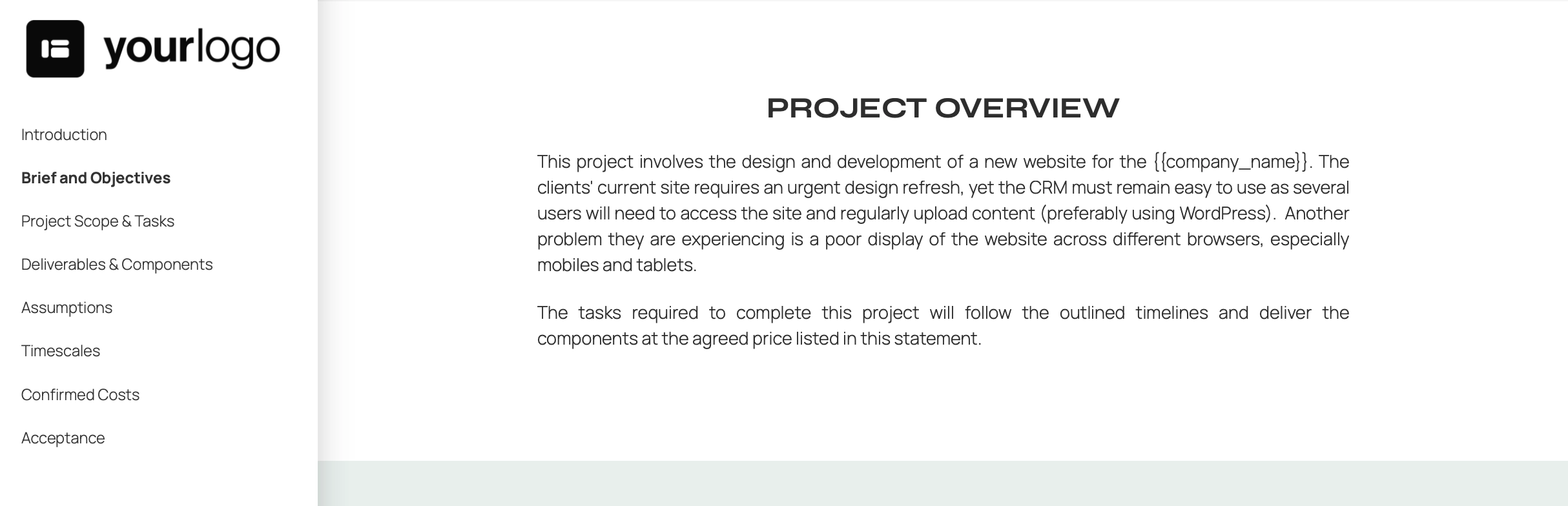
Precise language
Internal shorthand gets replaced with clearer, more formal descriptions.
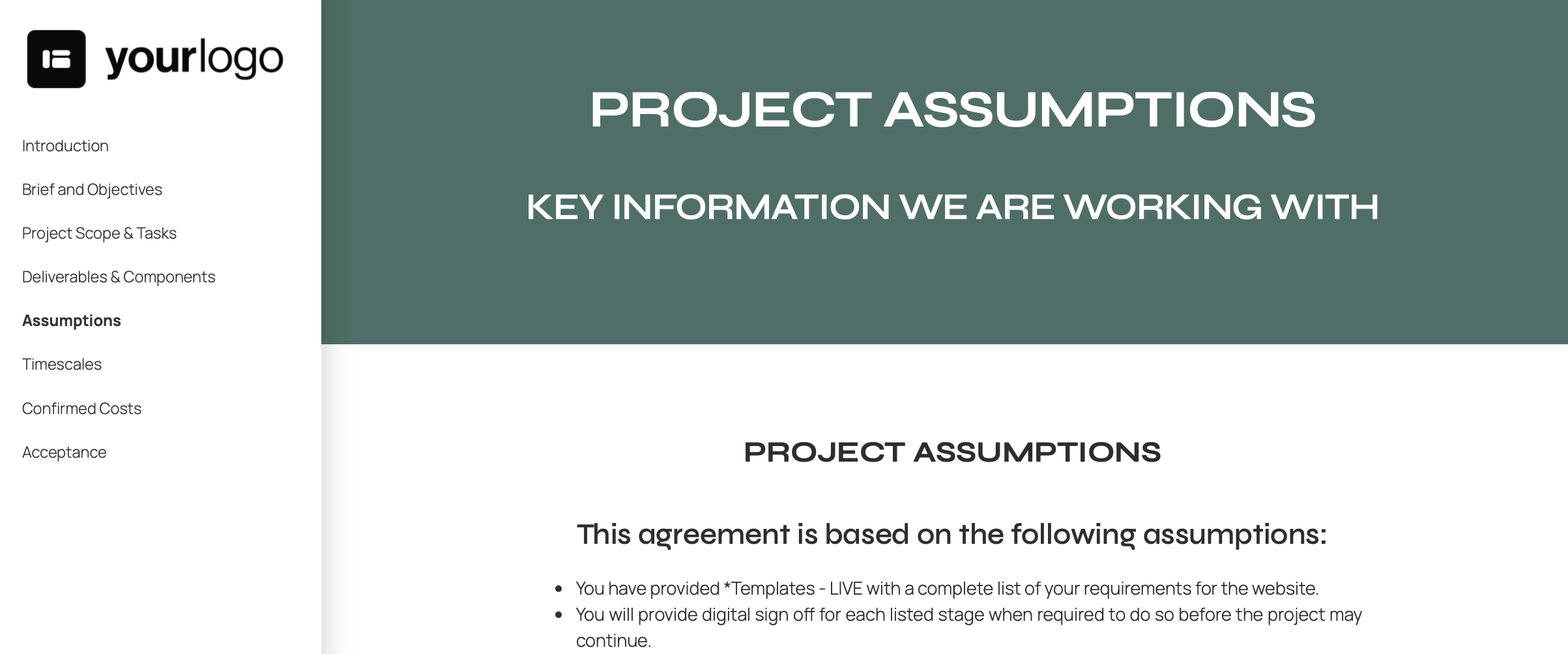
Assumptions
List out the conditions you're relying on before the work begins.
Defined deliverables
Anything vague gets clarified to prevent scope creep.

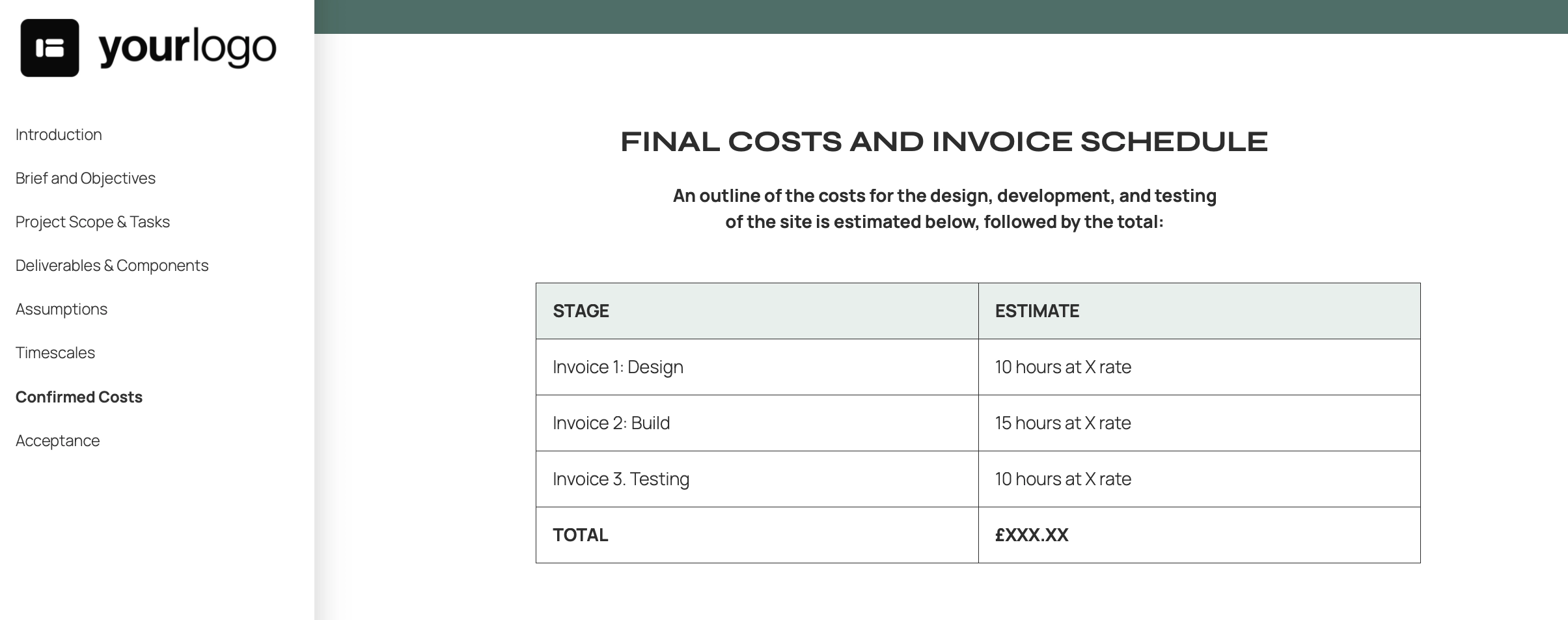
Budget turns into pricing
Internal cost estimates are translated into what the client will actually pay.
Approvals and change management
This is where you define how new requests are handled, approved, and billed.

Steal this statement of work template
Common mistakes when writing a scope of work
Even with a template and good intentions, things can fall through the cracks. These are the five mistakes that can derail your whole project.
1. Being too vague
“Enhance user experience” sounds useful, but it doesn’t outline tasks or expected outcomes. If two people can read a line and interpret it in two different ways, it’s not clear enough.
2. Skipping exclusions
This is how projects quietly double in size. If you don’t define what’s out, every request becomes a negotiation instead of a decision based on the original plan.
3. No clear definition of done
Without a clear finish line, the project drifts. There’s always one more tweak, one more improvement, one more round of feedback. Completion becomes a moving target.
4. Mixing internal with client language
What makes sense to your team rarely translates cleanly to a client. Internal scopes often include shorthand, assumptions, or implied knowledge. If you carry that over to a written document for the client, get ready for confusion.
5. Treating the scope as set in stone
A scope of work should set clear boundaries, but that doesn't mean it should prevent changes.
Your goal is to make sure changes are visible, discussed, agreed upon, and billed before they’re implemented.
Stop being part of the statistics
Most teams don't struggle to finish projects on time and budget because they lack skill. They struggle because they start with a loose idea and hope it works itself out over time. It won't.
Want fewer surprises, fewer awkward conversations, and no projects that drag on for longer than they should? Write the scope properly.
It's not glamorous work, but it will save your project from becoming part of the 52% where the scope keeps growing and the budget struggles to keep up.
Frequently asked questions on scope of work and statement of work documents