Sales presentation
Frames the problem and gives the buyer a reason to keep talking to you.
Buyer asks: Why should we change anything?

You spend months perfecting your internal sales enablement content. The call scripts cover every stage of the conversation. The battlecards cover every competitor. The objection-handling guides leave no awkward question unanswered.
Your rep uses it exactly as intended. They run a great call, handle every concern, and get the buyer interested. Then, they leave the room.
Two days later, the buyer opens the proposal and forwards it to a finance director who's never spoken to you. A department head jumps straight to the pricing. Procurement reads the terms without hearing any of the conversation that came before.
The deal is now in the hands of your external sales enablement content, and that's exactly where it falls apart.
Internal sales enablement content helps your rep sell. External sales enablement content helps your buyer buy.
Scripts, playbooks, and objection guides give the rep the right answers during the call. Proposals, case studies, pricing pages, sign-offs, and contracts give the buyer those answers once the call is over.

Internal content gets you through the conversation. External content gets your deal over the line. And if the two tell different stories, guess which one the buyer believes? The one in front of them.
That's why external sales enablement content can't be treated as an afterthought. It's the part of the sale that happens without you, not just paperwork that follows the sale.
Customer-facing sales enablement content needs to do four things:
If it can't do those four things without the rep explaining it, it fails the out-of-the-room test. Here's what that looks like across common types of external sales enablement content.
Frames the problem and gives the buyer a reason to keep talking to you.
Buyer asks: Why should we change anything?
Shows that you've already helped solve a similar problem for a previous client.
Buyer asks: Why should we believe you?
Connects the buyer's situation to your recommended solution.
Buyer asks: What will you do and why?
Explains the investment and helps the buyer choose an option.
Buyer asks: What will this cost and why?
Confirms the price for the products, services, and quantities requested.
Buyer asks: What is the final price?
Defines the deliverables, responsibilities, timeline, and exclusions.
Buyer asks: What exactly will be delivered?
Sets out the obligations, protections, and terms both sides accept.
Buyer asks: What are we committing to?
Buyer asks: How do we start?
This doesn't mean you need eight separate documents for each sale. One proposal can easily include all these pieces of content.
What matters is that every piece of content you add earns its place by helping someone make the next decision. Buyers rarely read your sales documents from beginning to end under ideal conditions.
One opens the proposal on a phone between meetings. Another receives a forwarded link with a message that says, “What do you think?” Finance sees the total before it sees the problem the money is supposed to solve.
Every section has to make sense to the person who lands on it. That doesn't mean repeating the entire sales pitch on every page. It means making sure each section still works when it’s read out of order and by someone you’ve never spoken to.
A sales presentation should make the buyer understand what needs to change and why it matters. If it opens with your company history, office locations, and awards, the buyer is still waiting to hear something about the problem that brought them to the meeting.
Start with what is happening in their world. For example, if an accounting firm's website attracts the wrong inquiries, don't lead with your design process. Show what the current structure is costing them and what a better outcome would look like.
A lot of case studies introduce the customer, mention how wonderful they were to work with, and finish with a vague line about saving time. Nice story, but not much use in a live deal.
The buyer needs something stronger:
For the accounting firm, you could include a case study about a famous retailer because everyone recognizes the name. Or you could use one about another professional services firm that had the same lead-quality problem.
The second will do more work because the buyer can relate.
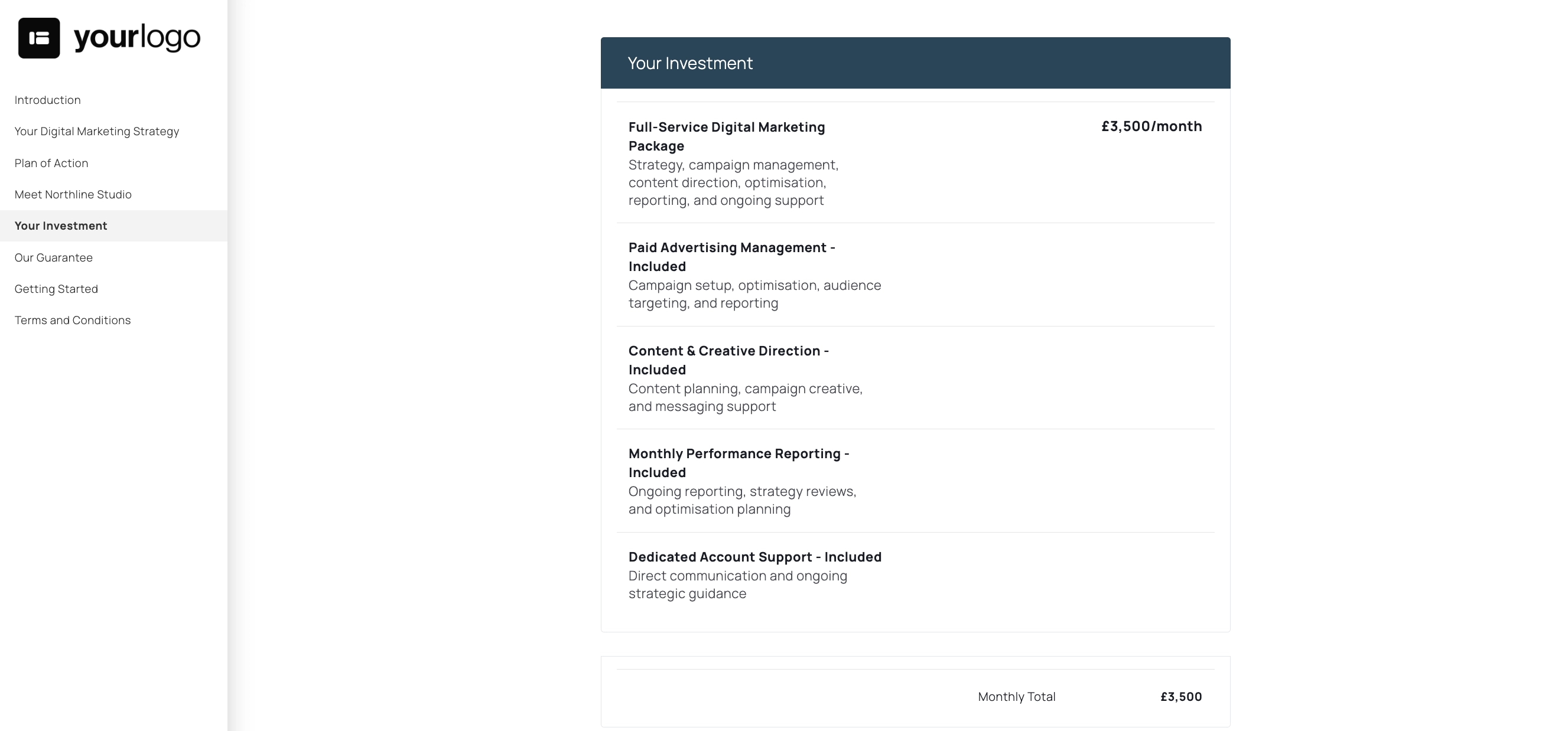
A total with no explanation is just a number. A list of every email, meeting, and 15-minute task isn't much better. Break the investment into meaningful phases and group your line items into logical categories.
Make fixed, estimated, recurring, and optional costs obvious. Show taxes, discounts, and what changes when the buyer adds or removes an option. And don't hide necessary costs to make the first total look cheaper. The buyer will find them eventually.
A scope of work should define what will be delivered, when the work will happen, and where the boundaries sit. If two people can read it and picture two different projects, it isn't finished.
Spell out the deliverables, milestones, responsibilities, exclusions, and how additional work will be handled.
Keep the language consistent with the pricing, too. A different label may look harmless internally. To the buyer, it can look like a different product.
A contract should turn the agreed deal into clear obligations and protections. It shouldn't introduce surprises after the buyer believes the decision has already been made.
The contract may need more legal detail than the proposal, but the scope, payment schedule, responsibilities, and commercial terms still need to match. If the proposal splits payment across three milestones and the contract asks for 50% upfront, the buyer has a reason to stop.
Cancellation periods, automatic renewals, usage limits, and late fees should be agreed upon before the signature stage. Reasonable terms become a trust problem when they appear without warning.
A sign-off document should confirm exactly what the buyer is approving and what happens once they do. Depending on the sale, that may be the full proposal, a pricing option, a project phase, a change request, or completed work.
Include the final scope, selected options, price, and payment schedule. Then, make the immediate next step clear.
If the buyer is ready to choose an option, approve the proposal, sign, or pay a deposit, let them do it from the document. Every extra file, email, and handoff gives the deal another place to stall.
The best way to find gaps in your sales enablement content is to look for questions and delays that repeat across real deals.
You don't need to guess what buyers want or create another document because somebody noticed an empty space in the content library. The evidence is already in your calls, proposal comments, follow-up emails, lost deal notes, and contract revisions.
If buyers repeatedly ask what makes up the total, your pricing isn't giving them enough information to defend the investment.
That doesn't mean they need an itemized list of every hour and task. They do need to see how the price breaks down across phases, what each option includes, which costs are recurring, or why one part of the work is necessary.
The proposal reached someone who wasn't on the call, but it hasn't brought the conversation with it.
That person can see what you're selling, but not necessarily why the company was considering it in the first place. The proposal may be missing the original problem, the cost of leaving it unsolved, the recommended outcome, or the reasoning behind your approach.
Add enough context for someone new to the deal to understand why the proposal exists. Otherwise, your sales rep has to repeat the pitch every time another decision-maker enters the room.
You don't have a credibility problem. You have a relevance problem.
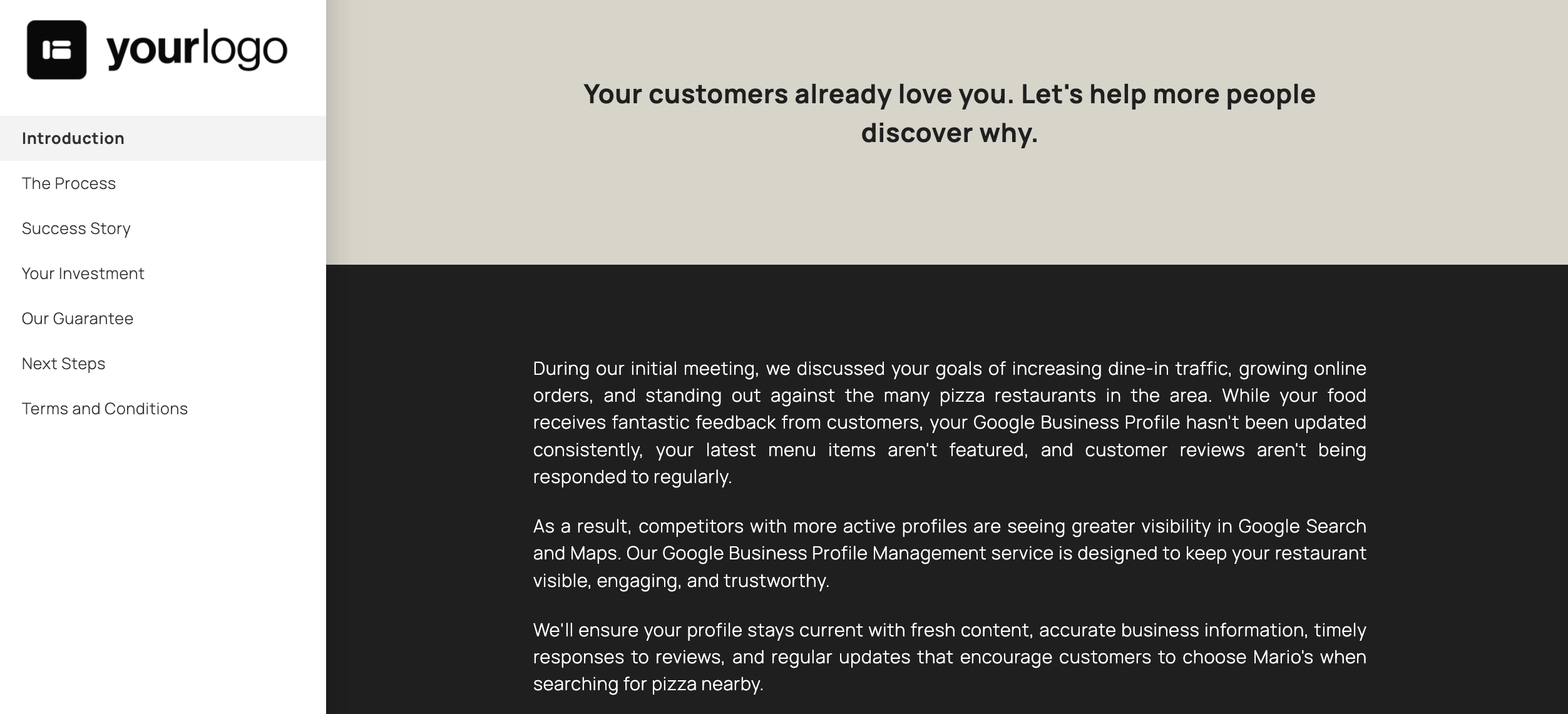
A long list of customers and impressive results proves that your product can work. It doesn't prove that it can work for a company with this buyer's industry, size, process, or particular problem.
Look at the doubts prospects raise and choose proof that relates to them directly. The best proof isn't always your biggest customer or most dramatic number. It's the example that makes the buyer's own result easier to believe.
Something important is showing up too late.
The contract may introduce an automatic renewal, cancellation period, payment condition, or buyer responsibility that wasn't clear in the proposal. Even when the term itself is reasonable, discovering it at the end makes the buyer wonder what else they missed.
Compare the objections raised during contract review with the information provided earlier. The terms that regularly cause discussion should be introduced before the contract arrives, in plain English, while the buyer is still evaluating the deal.
If the same clause gets questioned, rewritten, or escalated in deal after deal, the problem isn't that every buyer has unusually difficult lawyers.
The wording may be unclear, too broad, inconsistent with the proposal, or simply unacceptable to the type of customer you're selling to. You may need a clearer standard clause, an approved alternative, or a better explanation of what the term means.
The goal is to stop having the same avoidable negotiation every time. Start with your last 10 or 20 deals and record four things:
Then, fix the content closest to that decision. Don't automatically create another document. Improve the pricing, proof, scope, terms, or context the buyer already receives.
Good sales enablement content is built by removing the points where real buyers repeatedly get stuck.
Measure external sales enablement content by whether it helps deals progress, not simply whether the file was opened. An open tells you the buyer looked, but it doesn't tell you whether the document helped.
Better questions include:
Be careful with the answers as well. A buyer spending a long time on the pricing page might be interested, confused, or showing it to three other people. A case study attached to a won deal didn't necessarily win it.
Document analytics tell your rep where to look, but the next conversation tells them why.
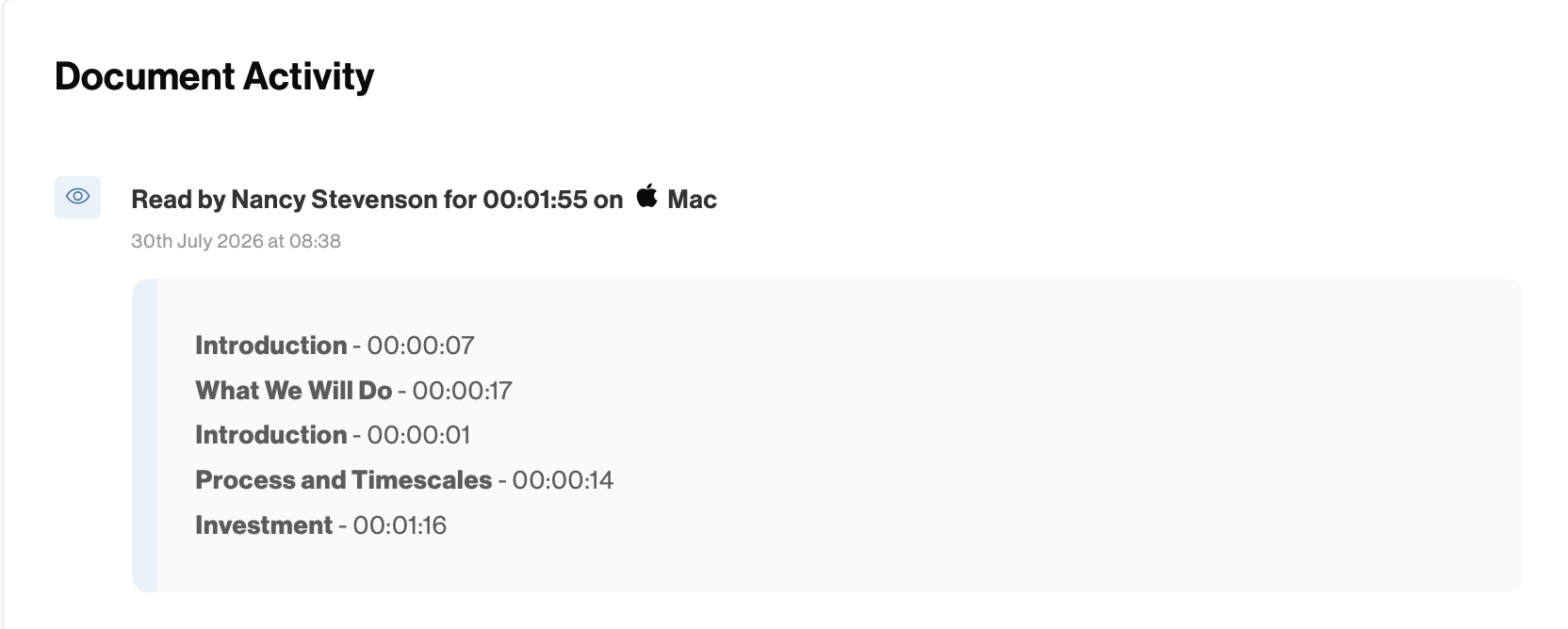
Your sales team's behavior matters, too. If the team keeps rebuilding an approved template, find out whether they're ignoring the process or the template no longer reflects how deals are made. Content nobody trusts enough to use isn't enabling anyone.
Internal sales enablement content gets your rep ready for the call. External sales enablement content has to finish what the call started.
That means giving the buyer proof they can use, a proposal they can understand, pricing they can defend, and terms they can approve.
Your rep won't be in every room where the deal gets discussed, but your content will. Make sure that it closes the deal for you.